Software
Overview
The software layer of the community zone is required to have a MEF 3.0 compliance and deliver the interoperability, automation and interface required to completely simplify and manage the provider to provider interactions and also also for a streamlined and federated experience for smaller retail providers and carriers accross multiple utility networks. Broadband Utilities are often limited in geographical size and considerations in order to address local needs. It is why it is important that they have a standardized API and automation for service orders, fulfillment and service activation which makes the adoption of the utilities frictionless for the customers regardless of the internal processes, and mode of operations for the utility operator. While the data structures are based off MEF LSO standards they leverage pieces of SID and eTOM information frameworks from TMForum as well as other standards body APIs.
Software Models
The software implementation is to deliver and interact with software models that are compliant from MEF 78.1 - MEF Core Model (MCM) for interactions with the majority of the APIs implemented.
Application Interfaces Requirements
Aligning business and technology within a service provider’s domain is critical for both maximizing the enterprise customer experience as well as driving operational excellence. The value of this alignment is multiplied when delivering enterprise digital and connectivity services across multiple providers.
The automation and orchestration of both business and technology—both within, and between service providers, intersecting with cloud providers—should deliver a seamless, unified experience for the digital enterprise.
Subscriber Interface
MEF’s Subscriber APIs focus on the enterprise’s need for a frictionless digital experience when interfacing with its service provider to access the digital resources they need—be they cloud-based, connectivity-oriented, or application-focused, whether located locally, remotely, globally, at the core or at the edge of a network.
MEF’s Subscriber APIs, more formally called MEF 3.0 LSO Cantata and LSO Allegro, provide the framework, resulting standards, and SDKs to develop APIs that automate enterprise-to-service-provider services orchestration.
images::eastwestapi.png[Subscriber APIs]
Together with the rest of the LSO APIs and framework, these APIs enable an enterprise to communicate their ICT intent through an automated process realized across the underlying network-based resources packaged by their service provider—a truly frictionless experience.
Intraprovider Abstractions
The demand for business velocity and agility drives the modern enterprise. In turn, these aspirations drive the modern digital service provider. Software-Defined Networking (SDN), Network Function Virtualization (NFV), and their various incarnations, have provided some of the necessary capabilities, but the challenge continues to be the ability to fully orchestrate a subscriber service, end-to-end. In other words, the ability to effectively communicate user intent that is then fully realized by the underlying network infrastructure, dynamically and automatically.
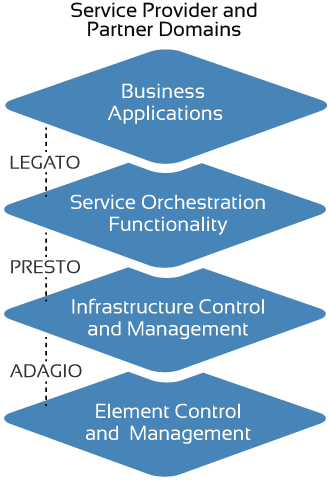
MEF’s LSO APIs—specifically those running ‘North-South’ within a provider domain—provide the framework to orchestrate services from the:
Business-application layer to the service-orchestration layer: LSO Legato. Service-orchestration layer to the infrastructure-control layer: LSO Presto. Infrastructure-control layer to the element-control layer: LSO Adagio. The result of the North-South APIs is operational automation from business application through to service instantiation on the physical and virtual network resources within a service provider.
Interprovider Interfaces
Because enterprises and retail service providers demand agility and speed—demands that are difficult to deliver in multi-provider services. As such, goal is to make inter-provider business and orchestration frictionless and that takes a combination of common services language (e.g. MEF 3.0 service standards) and automation (e.g. MEF 3.0 LSO APIs).
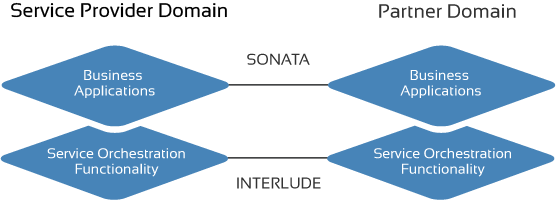
MEF’s East-West APIs, more formally called MEF 3.0 LSO Sonata and LSO Interlude, provide the framework, resulting standards, and SDKs to develop APIs that automate inter-provider business and orchestration. These East-West APIs support the federation of multiple providers across both business and operational elements to deliver a unified customer experience for the enterprise.
LSO Sonata
The LSO Sonata interface and its APIs address the business-to-business layer of inter-provider interactions, like quoting, ordering, and inventory.
LSO Sonata APIs address the business-to-business layer of inter-provider buying and selling at the commercial level. Much of the work to date has focused on this critical Interface Reference Point in the LSO Reference Architecture.
LSO Sonata APIs combine product-agnostic products and services schema to support all phases of business-to-business transactions using automation APIs for the retail-wholesale ecosystem.
LSO Sonata APIs address the business-to-business layer of inter-provider buying and selling at the commercial level. Much of the work to date has focused on this critical Interface Reference Point in the LSO Reference Architecture.
LSO Sonata APIs combine product-agnostic products and services schema to support all phases of business-to-business transactions using automation APIs for the retail-wholesale ecosystem.
The broadband utility should bring together service providers and a technology provider within the framework to accelerate the onboarding and operationalization of billing and settlement between two service-provider partners using DLT (Distributed Ledger Technology) and Smart Contracts. It provides a framework for multiple Smart Bilaterals, based on the xMEF114 DLT-Based Commercial and Operational Framework—Billing and Settlement, and used by both Buyer and Seller of LSO Sonata APIs.
LSO Interlude
LSO Interlude APIs address the service-orchestration to service-orchestration layer of inter-provider interactions, like performance, state, and dynamic control. The service orchestration functionality is analogous to the OSS functions of a service provider. Examples of Service Provider interactions handled by LSO Interlude APIs:
Request changes to dynamic parameters, as permitted by service policies, on behalf of an enterprise customer. Query operational state of the Service. Request instantiation of connectivity between two service interfaces. Receive event and performance telemetry.