Architecture
Overview
The access zone is required to meet all requirements expressed in terms of abstraction, security and vendor independence. Its architecture MUST at minimum have the following components as part of Access Zone Point Of Delivery (POD):
-
Broadban Network Gateway,
-
Optical Line Terminal,
-
Compute Fabric,
-
Optical Network Terminal.
Whereas different vendors provide different components of the Access Zone, they are expected to be compliant to their respective subset of specifications such that the Access Zone is compliant overall to all required specifications.
Functional Requirements
The following image provides the functional elements that are required at a minimum for a compliants solution. Additional elements maybe added for completeness to the units of delivery.
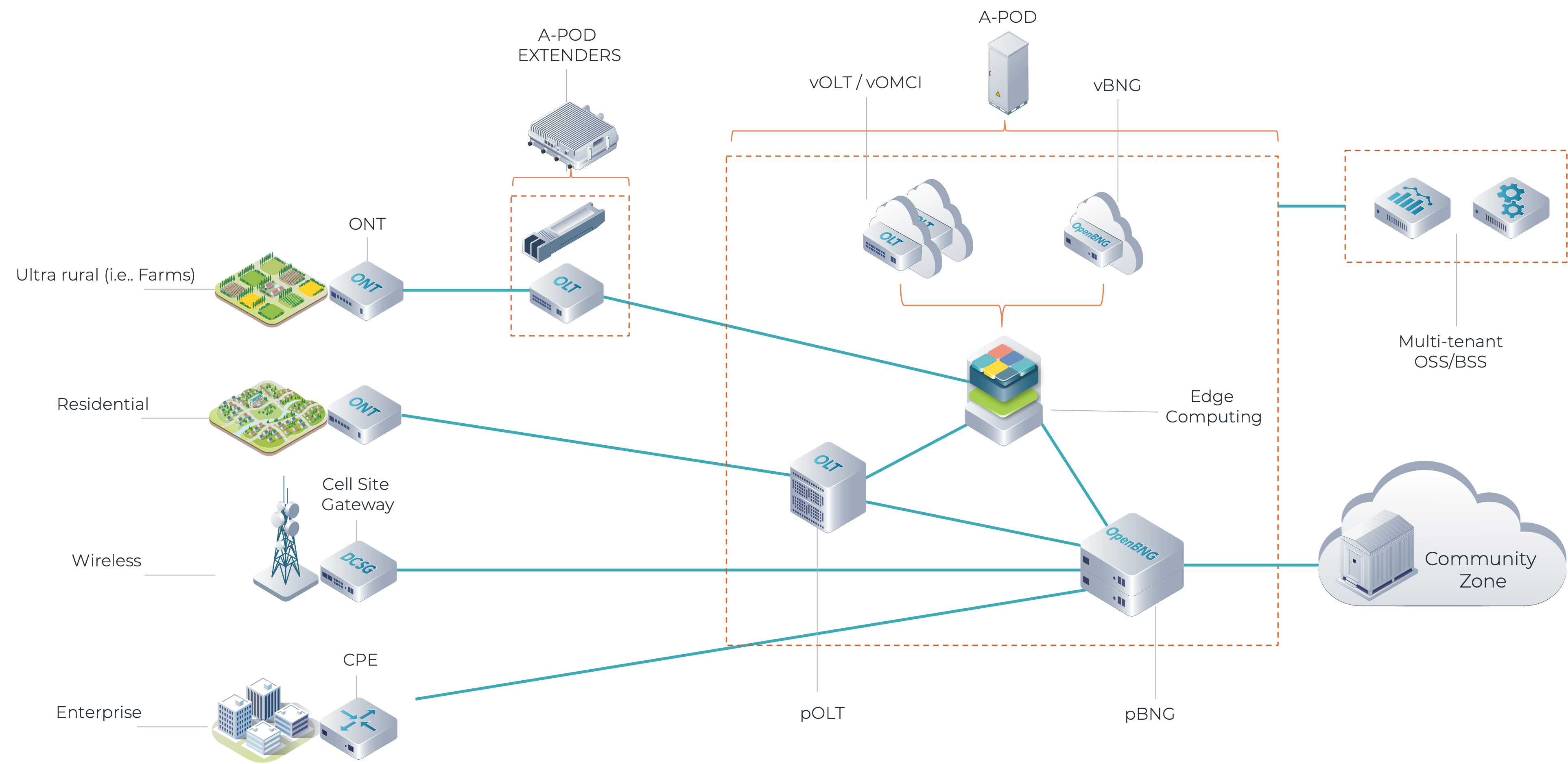
A-POD
The Access Zone POD or A-POD is a point of delivery of integrated software and hardware solutions that must contain the specifications compliant architectural components outlined below.
Broadband Network Gateway
The Broadband Network Gateway is expected to be compliant with meeting or exceeding the OpenBNG Technical Requirements. The Access POD must be able to have the required hardware capabilities in the form factor as well as leverage the ability to run virtual instances of the OpenBNG requirements a vBNG in the container fabric. This virtual BNG will not be required to have the same capacitities as the hardware BNG but is required to have the same interfaces for SDN controllers and orchestrators.
The following software providers have shown to have compliant software or hardware meeting the specifications:
| Software | Hardware |
|---|---|
|
|
This list is not meant to be an exhaustive list and provides only shortlisted compliant suppliers under the OpenBNG RFI activities by operators in December 2021.
PPPoE is not desired for L2BAS however whereas IPoE is preferred. Accordingly, the shared network infrastructure is expected to employ DHCP (v4 and v6) Relays capable of passing circuit-identifiers to AAA Servers operated by Retail Internet Service Providers which will provide IP address assignments through the DHCP Relays (for both DHCP v4 and DHCPv6) operated by the broadband utility operator.
Optical Line Terminal
The Optical Line terminal (OLT) and vendors solutions needs to be abstracted via an Open Broadband Access Abstraction layer which provides vendor independences and compliance with the point of delivery specifications.
For each OLT it is required for the Point of Delivery (APOD or APOD Extender) to have a virtual OLT function representation or virtual OLT proxy which provides the proper level of provisioning abstractions and may represent aggregate fabric under a vOLT proxy representation of all the various OLTs from one or multiple vendors.
Moreover, vOMCI functions for that specific OLT also needs proper representation in a localized or extended container fabric. This allows for consistent and coherent management of the OMCI capabilities without vendor lock-in.
The following vendors been involved in interoperability with the abstraction layer:
-
Altice Labs
-
Altran / CapGemini
-
Azores
-
Calix
-
FiberHome
-
Huawei
-
Iskratel
-
Nokia
-
Tibit Communications Inc.
-
ZTE
Compute Fabric
The Computre Fabric is a small compute node that can run at least the vOLT, vOCMI and vBNG functional services. These also should be leverageable by end users of emerging services to provide enhanced services such as caching, virtual firewalls, IoT gateway software, etc.
The compute fabric should be able to address a broad variety of use cases including 5G, AI, Edge Iaas/PaaS, IoT for both providers and enterprise edge domains. The fabric should be able to run multiple workloads such as VMs, Containers, micro services, etc.
The A-POD compute fabric should leverage the LF Edge initiative from the Linux Foundation and the various software solutions based on it. as part of the the operational flow of the fabric of the A-POD.
Operations System
A multi-tenant capable OSS/BSS is required to allow management, service provisioning and billing of services under the Access Zone. Moreover, the OSS and BSS must be capable of provisioning as well as gatering the information coming from the vOMCI and vOLT instances to provide the right operational dashboards for NOCs and other zone services integrations.
A-POD EXTENDER
The A-POD Extenders are meant to provide Remote OLT capacities to the A-POD while providing seamless integration on the abstraction layer from the A-POD Compute Fabric and OLT abstractions. Physical OLTs used in extenders may be from different vendors but will be abstracted properly for OSS