Hardware
Overview
To provide uniformity and consistency across broadband utilities the hardware must be abstracted in the Access Point Of Delivery (A-POD). These A-PODs are meant to be consistent across the architecture and must contain all the functional elements from the architecture under their respective specifications. The A-PODs can be dimensioned for capacity but it is expected that networks will have at least the flavors below.
APOD
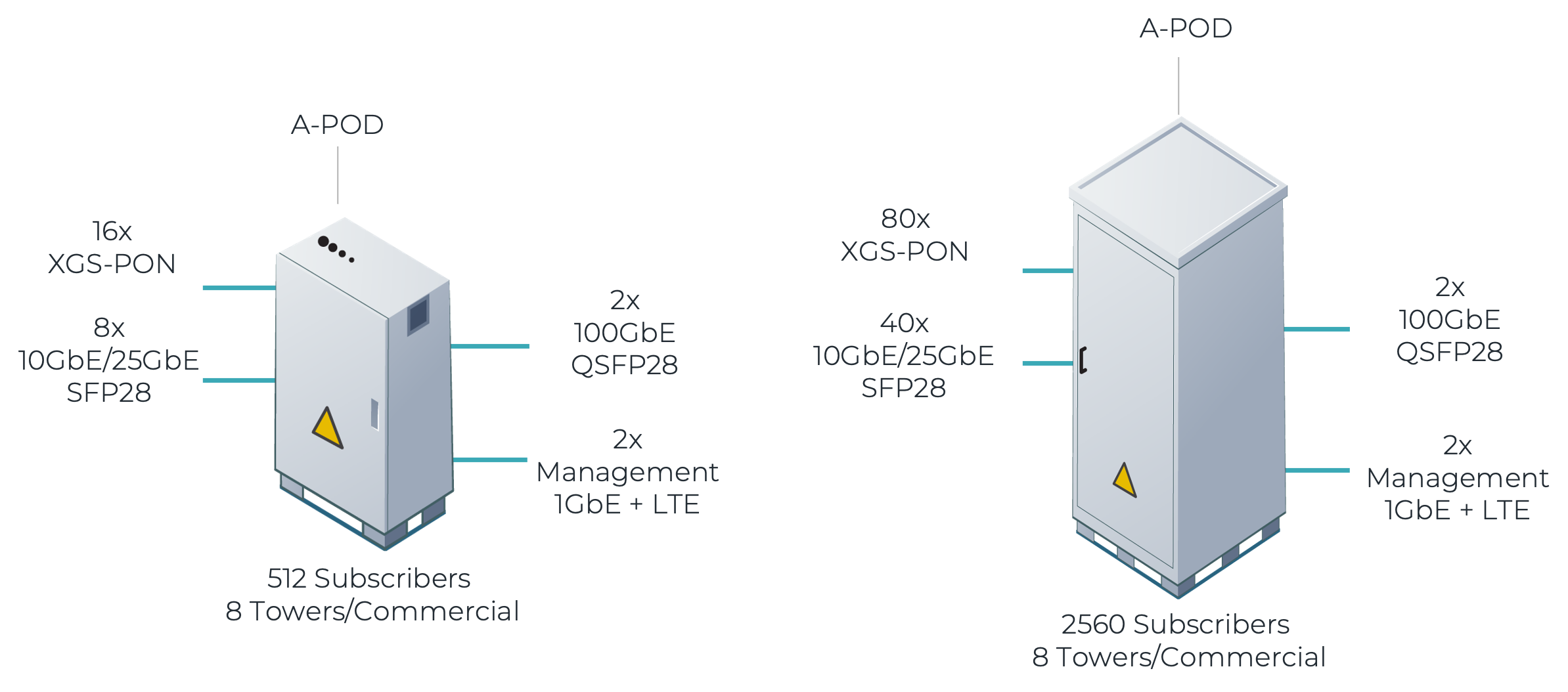
The A-POD should be available under two different sizes and support the underlying functional requirements.
Cabinet Requirements
The cabinets for the A-POD should be NEMA 3R Enclosures that are preinstalled with all the required components and wiring and ready for fiber splicing where applicable.
| Size | Small | Large |
|---|---|---|
Rack Units |
5RU |
20RU |
Payload Units |
3RU |
10RU |
Power |
-48Vdc ~400W |
-48Vdc ~1.2kW |
Batteries |
20 kWh |
50 kWh |
Network Equipment
The internals of the POD may be productized as a black box as long as all software and functional requirements are met however the following capacities need to be delivered for the underlying form factor to be consistent with design criteria.
| Size | Small | Large |
|---|---|---|
XGS-PON Ports |
16 |
80 |
10/25GbE SFP28 Ports |
8 |
40 |
100GbE QSFP28 Ports |
2 |
4 |
The A-POD uplinks ports should go to at least 2 different C-POD sites for diversity when connecting A-PODs to the Community Zone.
Edge Computing
The Edge Computing infrastructure supports IoT, 5G, AI applications as well virtual network functions (VNFs) and proxies that are required for the APOD management and control of the abstraction.
| Size | Small | Large |
|---|---|---|
Cores (vCore) |
16 |
64 |
Memory (GB) |
32 |
192 |
Storage (TB) |
1 |
4 |
The compute solution .
APOD EXTENDER
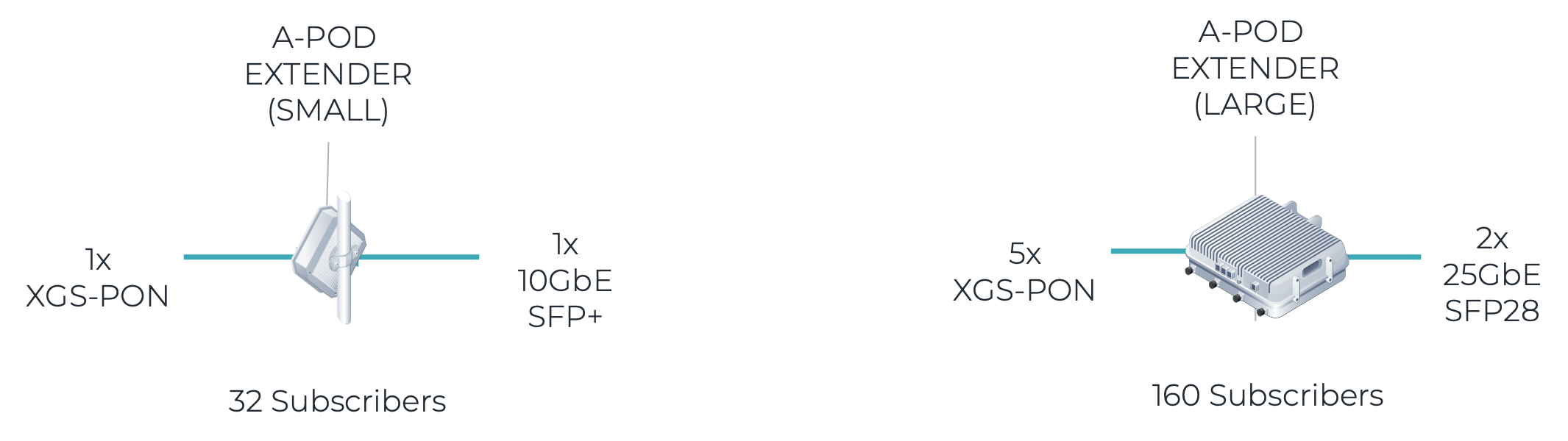
The A-POD EXTENDER should be available under two different sizes and meant to be installed on poles or buildings near power and are in clamshell or 2RU enclosures. They need to have the ability to work with the A-POD in instantiating their relative vOLT proxies and may or may have local compute capabilities or intelligence. They are mean to extend the reach of A-POD fabric on longer distances while leveraging to the greatest extent the management and control domains of the A-POD.
Enclosure Requirements
The APOD Extenders are meant to go outside on poles, buildings or under outdoor environments. As such the enclosures are not temperature regulated and it is expected that the equipment will be capable of handling the extended ranges accordingly.
| Size | Small | Large |
|---|---|---|
Type |
Clamshell |
2RU |
Compute |
No |
Yes |
Payload Units |
1RU |
2RU |
Power |
-24Vdc/-48Vdc ~50W |
-48Vdc ~200W |
Network Equipment
The extenders do not have the capabilities to provide enterprise services or towers site CPE routers however they are mean to provide additional reach to customers in rural environments where distances have more impact than density and capacity. They also have limited compute capabilities compared to the Edge Computing fabric provided by the A-POD.
| Size | Small | Large |
|---|---|---|
XGS-PON Ports |
1 |
5 |
10GbE SFP+ Ports |
1 |
0 |
10GbE/25GbE SFP28 Ports |
0 |
2 |
The A-POD extenders are made to uplink and automatically detect when connected to the commercial 10/25GbE ports from the A-PODs. All virtual OLT, virtual OMCI and virtual or physical BNG functionalities are provided by the A-POD and the extender is meant to be logically managed from that POD software instances and are just meant as a convenient reach into longer distances to manage low density areas and simplify deployments.